

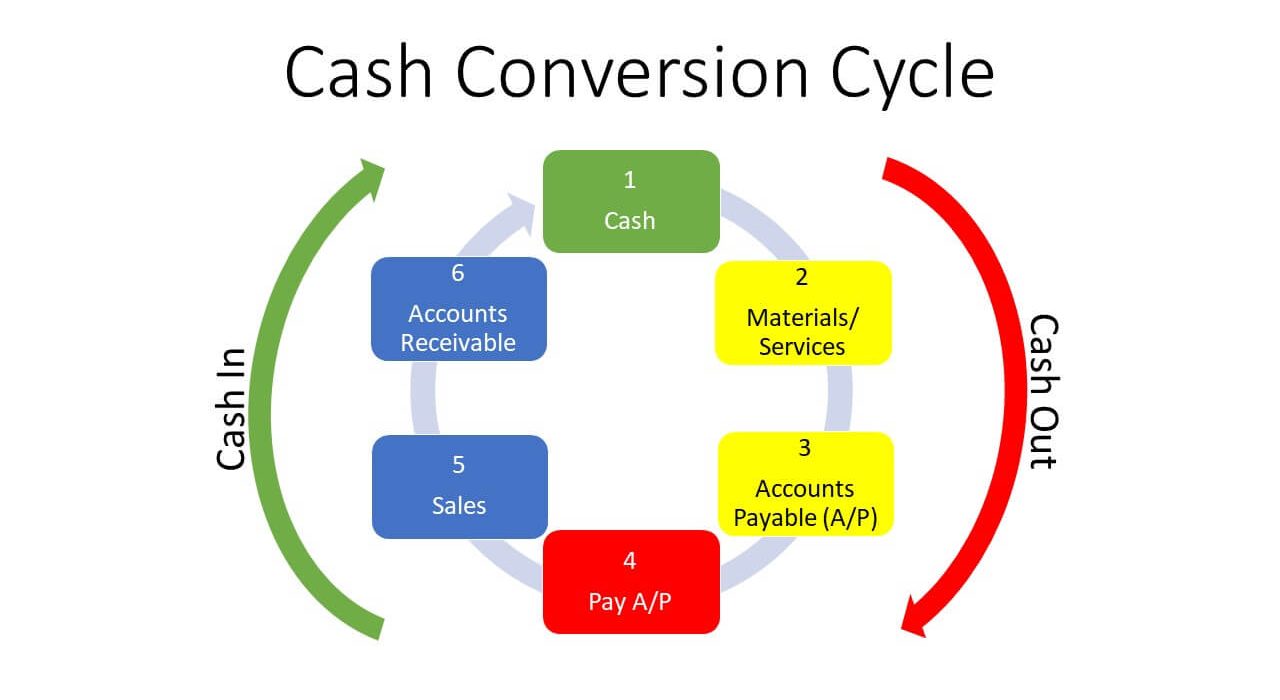
The cash conversion cycle (CCC) measures how many days it takes a company to convert its investments in inventory and other resources into cash flows from sales. It’s one of the most revealing efficiency metrics in business—and one of the most underused. A shorter cycle means a company is bringing in cash faster, which is often a sign of superior operational health and supply chain management.
Formula:
> CCC = DIO + DSO − DPO
Where:
- DIO (Days Inventory Outstanding) = how long inventory sits before it’s sold
- DSO (Days Sales Outstanding) = how long it takes to collect payment after a sale
- DPO (Days Payable Outstanding) = how long the company takes to pay its own suppliers
Breaking Down Each Component
| Component | Formula | What It Measures |
|---|---|---|
| DIO | (Average Inventory / COGS) × 365 | Days inventory is held before selling |
| DSO | (Accounts Receivable / Revenue) × 365 | Days to collect payment from customers |
| DPO | (Accounts Payable / COGS) × 365 | Days taken to pay suppliers |
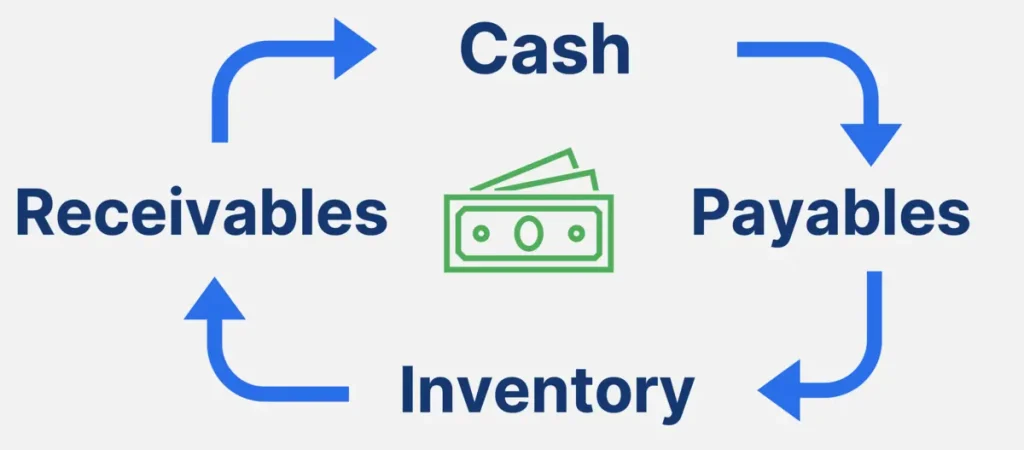
The logic: you pay for inventory (cash out), sell it, then wait to collect (cash in). The CCC tells you how many days cash is “trapped” in that cycle.
A Worked Example
Imagine a manufacturing company with these annual figures:
| Metric | Value |
|---|---|
| Revenue | $5,000,000 |
| COGS | $3,000,000 |
| Average Inventory | $500,000 |
| Accounts Receivable | $400,000 |
| Accounts Payable | $250,000 |
DIO = (500,000 / 3,000,000) × 365 = 60.8 days
DSO = (400,000 / 5,000,000) × 365 = 29.2 days
DPO = (250,000 / 3,000,000) × 365 = 30.4 days
CCC = 60.8 + 29.2 − 30.4 = 59.6 days
This means cash is tied up for about 60 days in the operating cycle.
What Does the Number Actually Tell You?
| CCC Value | Interpretation |
|---|---|
| Low positive (1-30 days) | Efficient operation; cash cycles quickly |
| High positive (60-120 days) | Cash is tied up longer; may need working capital financing |
| Zero | Cash comes in as fast as it goes out |
| Negative | Company collects cash before paying suppliers – very efficient (Amazon model) |
A negative CCC is the gold standard of working capital efficiency. Amazon, Walmart, and many large retailers achieve this – they collect payment from customers before they have to pay their suppliers, effectively using supplier credit as free financing.
Industry Benchmarks
CCC varies dramatically by industry. Comparing within your sector matters more than comparing to a global average.
| Industry | Typical CCC Range |
|---|---|
| Grocery / retail | -10 to +20 days |
| E-commerce | -20 to +10 days |
| Manufacturing | 40-90 days |
| Construction | 60-120 days |
| Technology (hardware) | 30-70 days |
| Healthcare | 40-80 days |
How to Improve the Cash Conversion Cycle
Reduce DIO: Move inventory faster through better demand forecasting, just-in-time ordering, or reducing slow-moving SKUs.
Reduce DSO: Offer early payment discounts, tighten credit terms, invoice immediately upon delivery, and follow up on overdue accounts promptly.
Increase DPO: Negotiate longer payment terms with suppliers – pay in 45 or 60 days instead of 30 without damaging the relationship.
Each of these moves frees up cash without requiring additional financing. For businesses under cash pressure, improving the cash conversion cycle is often faster and cheaper than seeking a loan.
The Bottom Line
The cash conversion cycle is a diagnostic tool every business owner and analyst should understand. A low or negative CCC means the business is efficient with cash. A high CCC means money is sitting idle in inventory or receivables – and that’s an opportunity waiting to be fixed.